Studio Safety and Equipment Handling: What Actually Works
Safe practice in a photography studio, covering stands, power, heat and heavy props.
 Imogen Clarke
Key takeaways
- Sandbags: stabilize light stands and booms
- Cable management: loose cables are a trip hazard
- Most useful single move: Sandbag every raised stand.
- Commonest mistake: Unweighted stands with heavy modifiers.
- Bring in help when any of the situations under "When to bring in help" below describe your project.
Why it matters
Studio accidents injure people and destroy equipment, and most are prevented by routine habits.
The numbers, in one place
These are the figures the standards and platform documentation actually specify.
| Measure | Figure |
|---|---|
| Sandbags | stabilize light stands and booms |
| Cable management | loose cables are a trip hazard |
| Heat | continuous lights and modifiers get hot |
| Electrical load | multiple lights can overload circuits |
What good looks like
You do not have to do all of it at once, and the order below is not sacred.
- Sandbag every raised stand
- Tape down or route cables safely
- Allow lights to cool before packing
- Check electrical loads on circuits
- Brief everyone on set about hazards
What to avoid
What to steer clear of, and why it catches teams out.
- Unweighted stands with heavy modifiers
- Cables across walkways
- Overloaded power strips
- Untrained helpers moving equipment
Where this sits in Photography & Product Visuals
Studio Safety and Equipment Handling is one part of how we approach Photography & Product Visuals work. It rarely arrives on its own: the decisions above interact with everything else on the project, which is why they are worth settling early rather than at review.
Who this is actually for
Most people who end up on a page about Studio Safety and Equipment Handling got here for a practical reason. A project is about to start, a deliverable came back wrong, or a quote landed and nobody in the room could tell whether it was fair.
Any of those is a fine reason to be here. What follows covers the whole thing: what the work involves, what it costs in the US, how long it takes, what we need from you, and how to tell whether what comes back is any good. Skip to whichever part you need.
When occasional turns into ongoing
There's usually a moment when photography & product visuals stops being something you handle between other things and starts being a job. It tends to look like this:
- The work is landing on someone whose actual job is something else, and their actual job is slipping.
- Volume has stopped being occasional and started being weekly.
- Quality varies depending on who happened to be free that day.
- You are turning down opportunities because production cannot keep up.
- The same fix keeps getting made because nobody wrote down how to do it right.
- You are paying for software seats that get used a few days a month.
If two or three of those are true, the question isn't really whether to get help. It's whether to hire, to use a freelancer, or to work with a studio — and there's a section further down that lays out the trade-offs honestly, including the cases where hiring us is the wrong answer.
How the work actually runs
Here's the sequence a photography & product visuals job actually follows. It isn't a marketing diagram — it's the order things have to happen in, and most of the expensive problems in this field come from doing one of these steps out of order or skipping it entirely.
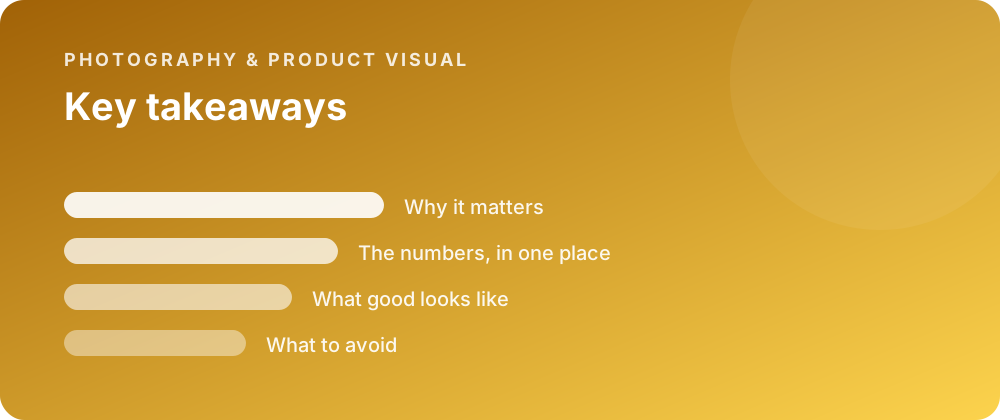
1. Plan the shot list
Every product, every angle, every detail, agreed in writing. A shoot without a shot list produces beautiful images of the wrong things.
2. Prep
Products cleaned, steamed, assembled and checked. This takes longer than anyone expects and doing it on the shoot day costs studio time.
3. Set the look
Lighting built and documented — positions, modifiers, power, camera settings — so session four matches session one.
4. Shoot the reference
One product photographed and approved before the rest of the range. The same principle as retouching: establish the standard, then match it.
5. Production shoot
The range, against the documented setup, with a color reference in frame at every session.
6. Select
Culling to the selects, reviewed with you rather than delivered as a dump of everything.
7. Post
Color management, cleanup, cut-outs and every crop the layout needs, generated from the master.
8. Deliver
Color-managed masters, web derivatives, and embedded rights metadata that survives export.
Where does Studio Safety and Equipment Handling fit? Usually somewhere in the middle of that sequence, and it inherits every decision made before it. That's the argument for settling scope early: a change at stage two is a conversation, and the same change at stage seven is a rebuild.
The numbers, and where they come from
These are published thresholds, not our opinions. Where a standards body or a platform has stated a figure, that figure is here and the body is credited at the bottom of the page. Where nobody has published one, you won't find a number invented to fill the gap.

What it costs in the US
Here's what this generally costs in the United States. Treat it as a sanity check rather than a price list: the honest number depends on the job, and anyone who gives you a firm price without looking at the work is guessing.
| Type of work | Typical range | What that buys |
|---|---|---|
| Studio day rate | $800 – $3,500 per day | Photographer, studio, lighting and basic post. Product count depends on complexity. |
| Per-product packshots | $15 – $75 per product | Simple products, consistent setup, volume pricing, standard angles. |
| Lifestyle and campaign | $3,000 – $25,000+ per day | Styling, models, location, art direction and full post. |
Those are wide ranges, and they're wide for a reason. Here's what moves a job from one end to the other.
What actually drives the price
- Number of products and angles
- Angles per product multiplies faster than the product count does.
- Styling and props
- A packshot is one thing. A styled lifestyle set with props, backgrounds and a stylist is another.
- Models
- Casting, fees, usage rights and time on set. Usage is often the larger number, and it is time-limited.
- Location
- On location means travel, permits, power, weather and less control than a studio.
- Post-production depth
- Basic cleanup is included in most day rates. Heavy retouching is a separate line.
- Usage rights
- Where images will be used, for how long, and in what territory. This is priced, and it is where a cheap quote usually turns expensive.
How the money is usually structured
Separately from how much, there's the question of how. Five models cover almost everything in this industry, and the right one depends on how well the job can be described before it starts.
- Per unit
- A fixed price per image, per minute, per page, per asset. Best when the work is genuinely repeatable and you can describe one unit precisely. It is the easiest model to budget and the easiest to argue about, because everything hinges on whether your idea of one unit matches ours. Settle that on a sample before you settle it on an invoice.
- Hourly or day rate
- You buy time, and the output is whatever that time produces. Honest when nobody can scope the job yet — a rescue, an unknown archive, an exploratory phase. Ask for a not-to-exceed number anyway. An open hourly arrangement with no ceiling is a budget with no floor.
- Fixed project fee
- One number for a defined scope, usually with a stated number of revision rounds. The model most clients prefer and the one that punishes a vague brief hardest. The fee is only fixed if the scope is, so expect the scope document to be more specific than feels comfortable. That specificity is what protects you.
- Monthly retainer
- A set amount of capacity reserved for you every month. Worth it once the work is continuous rather than occasional — a catalog that refreshes, a channel that publishes weekly, a site that keeps changing. Below roughly ten to fifteen hours a month it usually costs more than buying the work as it comes.
- Value or outcome based
- Pricing tied to a business result rather than to effort. Rare, and rarely as clean as it sounds. It works where the outcome is unambiguous and attributable, and falls apart where it is neither. Treat an outcome-based proposal with the same scrutiny you would give any other claim about attribution.
If you want a real number rather than a range, the fastest route is to send us the actual brief — scope, volume, deadline, and a couple of sample files if you have them. That's usually enough for a fixed price rather than an estimate.
How long it takes
How long should this take? Here are the usual durations, with the caveat that every one of them assumes decisions get made when they're asked for.
| Phase | Usual duration |
|---|---|
| Planning and shot list | 1–2 weeks |
| Prep and sample delivery | 3–7 days before the shoot |
| Shoot | 1–5 days depending on range size |
| Selects | 2–3 business days |
| Post and delivery | 5–10 business days |
One thing worth saying plainly: the most common cause of a late project isn't production. It's waiting — for content, for a decision, for one person to look at something. If you want a project to move quickly, the highest-leverage thing you can do is name one person who can say yes and make sure they're available. That single change is worth more than any amount of chasing.
Rush work is possible and it's genuinely more expensive, because it means real people working real overtime or a job jumping a queue somebody else is in. We'll always tell you what a rush actually costs before you commit to it.
What to send us
A brief doesn't need to be long. It needs to be specific about a handful of things, and vague about everything else is fine.
What belongs in the brief
- Who it is for
- The audience, in one sentence, in your own words. Not a persona document — a sentence.
- What it has to do
- The action you want someone to take, or the decision you want them to be able to make.
- Where it will live
- Every placement, at every size. This is the single most common omission, and it is the one that causes reshoots and recrops.
- What already exists
- Brand guidelines, prior work, the files nobody likes. Especially the files nobody likes, and why.
- What is fixed
- Colors, typefaces, legal copy, platform requirements, anything that is not up for discussion.
- What good looks like
- Two or three references, plus one example of something you actively dislike. The dislike is more useful than the likes.
- The real deadline
- The date something has to be live, not the date you would like to see a draft. Say which one you are giving.
- Who signs off
- One name. A brief with four approvers and no decider is a brief that will cost you two extra revision rounds.
Two of those deserve emphasis, because they're the ones that cost money when they're missing. Where it will live — every placement, at every size — is the omission that causes reshoots and recrops. And who signs off is the one that quietly adds revision rounds: a project with four approvers and no decider will always cost more than one with a single name on it.
Specific to Studio Safety and Equipment Handling
On top of the general brief, this particular job benefits from you having settled the following before anyone starts:
- Sandbag every raised stand
- Tape down or route cables safely
- Allow lights to cool before packing
- Check electrical loads on circuits
If you've got files ready now, you can send them straight over — they go to private storage rather than to an inbox, and nothing is public. If you'd rather see the standard before committing to anything, try us on a couple of files first. No card, no commitment, and if it's not what you need you've lost nothing but an afternoon.
How to check what comes back
You don't need technical expertise to review this well. You need a method, and it takes about ten minutes to learn.
- Check it where it will live
- Approve a web asset in a browser, a print asset on paper, an audio mix on a phone speaker. Approving a deliverable in the tool that made it is how problems reach the public.
- Check the edges, not the middle
- The middle is almost always fine. Look at the corners, the smallest size, the longest string, the darkest area, the last ten seconds.
- Check one thing at a time
- Color, then type, then spacing, then content. A review that tries to see everything at once sees the loudest thing and misses the rest.
- Collect feedback before you send it
- One consolidated list beats six emails. Contradictions inside your own organization are cheaper to resolve on your side than on ours.
- Be specific about what is wrong
- "Make it pop" costs a revision round. "The headline is hard to read against the sky, can we darken the area behind it" costs ten minutes.
- Say what is right too
- Not out of politeness. If you only flag problems, the next round can lose the thing you liked without anyone knowing it mattered.
The bar we hold ourselves to
So you know what you're measuring against, here's what gets checked on our side before anything reaches you. None of it is optional, and none of it is charged as an extra.
- A color reference in frame at every session, so a reshoot months later can be matched
- Lighting setup documented with a diagram and settings, not held in one person's memory
- Focus checked at 100% on the details that sell the product
- Every crop the layout needs shot for, not cropped out of a frame composed for something else
- IPTC creator, credit and usage metadata embedded and verified to survive export
- Delivered in sRGB for web and the working space you specified for print
Red flags specific to Studio Safety and Equipment Handling
If you see any of these in what comes back, say so. They're all fixable, and they're all cheaper to fix now than after it's published.
- Unweighted stands with heavy modifiers
- Cables across walkways
- Overloaded power strips
- Untrained helpers moving equipment
You can see how we present finished work — including the before and after — in the portfolio. Anything marked as a sample is our own demonstration piece rather than a client project, and it says so on the item.
Three situations you might recognize
Abstract advice is easy to agree with and hard to use. These are the shapes this kind of problem actually arrives in, and what we'd do about each one.
A range shot across three sessions that never matched
No color reference, no documented lighting, two photographers. We rebuilt a single setup, documented it, and reshot the outliers. The category page stopped looking like three different brands.
Images rejected by a marketplace
Main images had an off-white background and were below the minimum pixel size. Neither was visible to the eye; both were visible to the validator.
A campaign whose usage expired mid-flight
Model usage was licensed for twelve months in one territory, and the campaign ran longer and wider. Renegotiated at short notice and at a premium, when reading the release at the start would have cost nothing.
None of those needed heroics. They needed somebody to look at the right thing early, which is most of what experience buys you in this field.
In house, freelance, studio, or a model?
This is the decision underneath "how much does it cost", and it deserves a straight answer rather than a pitch. There are four ways to get photography & product visuals work done, and we're only the right choice for some of them.

Keep it in house
Someone on your payroll does it.
What's good about it: Fastest feedback loop there is, deepest product knowledge, no briefing overhead for small changes.
What's not: You are buying a person, not a job: their vacation, their sick days, their ceiling, and the software. It stops making sense the moment demand is spiky, because you pay for the peak all year.
Hire a freelancer
One specialist, engaged directly.
What's good about it: Cheapest way to buy real expertise, and you get the actual person who does the work.
What's not: One person is one point of failure. No cover, limited throughput, and if they move on mid-project you inherit their files and their conventions.
Use a studio
A team with a process, a review layer and cover.
What's good about it: Handles volume and variety, carries the QC step, and does not disappear when one person is sick.
What's not: More expensive per hour than a freelancer, and you are one client among several. Worth it when consistency across a lot of output matters more than the lowest rate.
Use a model
Generative or automated tooling, with or without a person checking.
What's good about it: Genuinely fast and genuinely cheap on the parts it is good at, and it does not get tired on page four hundred.
What's not: It is confidently wrong in ways that are hard to spot at a glance, and the parts it fails at are the ones a client notices: hands, text, counts, edges, continuity. Nothing should ship without a person having looked at it, which is why our AI work is priced with the review included rather than as a discount.
The short version: if the work is constant and central to what you do, hire. If it's spiky, or it needs a range of skills you can't justify employing, use a studio. If it's one specialist thing and you've found the right specialist, use them. We'd rather tell you that up front than take on a job we're the wrong shape for.
The US rules worth knowing
This isn't legal advice and we're not lawyers. It's a list of the American rules that come up often enough in this kind of work that not knowing about them gets expensive. If any of it applies to you, it's worth twenty minutes with someone who is a lawyer.
Model and property releases
Commercial use of a recognizable person in the United States generally requires a signed model release, and many states have right-of-publicity statutes with their own requirements. Recognizable private property and some trademarked buildings can need a property release too.
Drone photography and FAA Part 107
Commercial drone operation in US airspace requires a Remote Pilot Certificate under FAA Part 107, plus airspace authorization in controlled areas. A photographer offering aerial work should be able to produce the certificate.
Marketplace image specifications
Amazon, Walmart, Target and other US marketplaces publish binding image requirements — pure white main-image backgrounds, minimum dimensions, frame-fill percentages, restrictions on text and props. Enforcement is automated, so these are specifications rather than preferences.
And the general commercial stuff
Whatever the discipline, buying professional services in the United States raises the same handful of questions. These are the ones clients ask us most.
- Contracts and statements of work
- A statement of work that names the deliverables, the number of revision rounds, the ownership terms and the payment schedule is worth the hour it takes to read. Most disputes in this industry are not about quality; they are about two people having understood "done" differently.
- Ownership and work made for hire
- Under US copyright law, work created by an independent contractor generally belongs to the contractor unless there is a written assignment or it falls into one of the narrow statutory work-made-for-hire categories. That surprises a lot of buyers. Get the assignment in writing; any studio that hesitates is telling you something useful.
- Paying an outside supplier
- A US business paying a US contractor normally collects a Form W-9 and may need to file a 1099-NEC; paying a non-US supplier usually means a W-8BEN or W-8BEN-E instead. Your accountant will want these before the first invoice, not after the last one.
- Sales tax on services
- Whether a creative or digital service is taxable varies by state, and several states tax some digital deliverables and not others. It is worth one question to your accountant before a large engagement rather than one letter from a state revenue department after it.
- Advertising claims
- The Federal Trade Commission holds advertisers responsible for claims made in their marketing, including claims made in images. A retouched product photo that no longer represents the product is an advertising problem before it is a design one, and the liability sits with the advertiser rather than the retoucher.
- Accessibility
- Title III of the Americans with Disabilities Act has been read by US courts to cover websites in many circumstances, and federal agencies and their contractors are bound by Section 508, which points at WCAG. Accessibility is cheaper designed in than litigated out.
Our own terms are published rather than sent on request: you can read the terms and conditions, the payment terms, the refund policy and the confidentiality and NDA position before you talk to anybody. If something in them doesn't work for you, say so early — most of it is negotiable and all of it is better settled before the work than after it.
Questions to ask anyone quoting for this
Including us. If a supplier gets cagey about any of these, that's the answer to the question you were actually asking.
- Who is actually doing the work?
- Ask whether it stays with the person you are talking to, moves to a team, or gets subcontracted. None of those is wrong. Not knowing is.
- What exactly is a revision?
- Ask what counts as a revision versus a new brief, and how many are included. This is the single most common source of a bill you did not expect.
- Who owns the output?
- Get it in writing, including the working files. "You own the final" and "you own everything" are very different positions, and the second one costs more for a reason.
- What happens if it is wrong?
- Ask what a redo costs and how fast it happens. A studio with a clear answer has had the conversation before.
- Can I see work like mine?
- Not a showreel — work in your category, at your volume, with the constraints you have. A beautiful portfolio in another category proves taste, not fit.
- How do you handle my files?
- Where they are stored, who can reach them, how long they are kept, and what happens at the end. If you are sending anything unreleased, get this in the contract.
- What do you need from me?
- A supplier who cannot answer this has not thought about your side of the job, and you will discover that at the deadline.
One more, and it's the one people are most embarrassed to ask: what would make you turn this job down? A studio that has never turned work away is a studio that takes everything, and that tells you something about how carefully it's going to be handled.
The words people will use at you
Every field has vocabulary that gets deployed as a shortcut and lands as a barrier. Here's what the common terms in photography & product visuals actually mean, in plain English. You shouldn't need this to buy the work, but it makes the conversation shorter.
- Packshot
- A clean product photograph on a plain background. The workhorse image of e-commerce.
- Shot list
- The agreed inventory of what will be photographed and from where. The document that makes a shoot efficient.
- Color reference
- A calibrated target photographed in the scene so color can be matched objectively later.
- Raw
- The unprocessed sensor data. More latitude to correct, and the only sensible thing to shoot for commercial work.
- Tethered shooting
- Shooting straight to a computer so images can be reviewed at full size on set, while it is still cheap to fix them.
- IPTC metadata
- Embedded fields carrying creator, credit, contact and usage terms. It is what proves provenance later.
- Usage rights
- Where, how long and in what territory an image may be used. Separate from ownership, and usually what you are actually buying.
- Model release
- Written permission to use a recognizable person's image commercially. Not optional in the United States.
- Depth of field
- How much of the image is in focus. A creative decision that becomes a technical problem on deep products.
- Focus stacking
- Combining several frames focused at different distances so a whole product is sharp. Standard for jewelry and small goods.
There's a fuller reference library if you want to go deeper on any of these, and everything in it is written the same way — plainly, with sources.
Questions people ask before hiring
These are the ones that come up on almost every inquiry about Studio Safety and Equipment Handling, answered straight. If yours is not here, ask it — nobody will put you on a mailing list for it.
How much does this cost?
US market rates for photographing products and spaces so that a whole range looks like it belongs to one brand start around $800 – $3,500 per day for the simplest work and climb from there with complexity, volume and turnaround. We price per project once we have seen the brief, because a number quoted without looking at the files is a number that changes later.
Can you give me a fixed price?
Usually, yes — once the scope is written down. A fixed price needs a fixed scope, so expect the scope document to be more specific than feels necessary. That specificity is what protects you from a variation invoice.
How quickly can you start?
Planning and shot list normally takes 1–2 weeks. How soon that starts depends on the queue, and we will tell you the real date rather than the one you want to hear.
What do you need from me to begin?
A brief, the files, and the name of the one person who can approve things. The third one matters more than people expect: projects with a single decider finish measurably faster than projects with a committee.
Who owns the finished work?
You do, including the working files, and it is written into the terms rather than left to be assumed. Under US copyright law work by an outside contractor does not transfer automatically without a written assignment, so this is worth checking with any supplier.
What if I do not like it?
Tell us specifically what is wrong and we will fix it. Revision rounds are stated in the quote so nobody is guessing. If the standard is genuinely not what you need, the refund policy says what happens, in writing, before you spend anything.
Do you work with US clients?
Yes, and the hours overlap the US business day. Pricing is in US dollars, deliverables are specified against the American standards that apply — ATSC, the ADA and Section 508, FTC advertising rules, US marketplace requirements — rather than the European equivalents that a lot of studios default to.
Can I try before committing?
Yes. Send a couple of real files and we will do the work to your brief, free, with no card and no commitment. It is a better test than any portfolio, because it is your material and your standard.
Is my material kept confidential?
Yes. Files go to private storage rather than to an inbox, nothing is published without your say-so, and we will sign your NDA or use ours, whichever you prefer.
What is the most common reason a project like this runs late?
Waiting for a decision. Not production, not revisions — waiting. If you take one thing from this page, make it that.
Where to go next
- Photographing Bundles and Multi-Product Sets: The Decisions That Matter
- A Practical Guide to Remote Art Direction on Shoots
When to bring in help
Bring in help when setting up a new studio space.
Where this comes from
- Capture One — Learning resources
- U.S. Small Business Administration — Business insurance
How this page was put together
Every figure, practice and warning above is taken from the standards, platform documentation and published research named in Where this comes from. Nothing here is inferred or generalized beyond what those bodies publish: where they give a number, it is their number, and where they are silent, so are we. Pages are rebuilt whenever the underlying record changes. Our own opinions, where we have them, live in the case studies and are signed.
Working on something like this?
We take on Photography & Product Visuals work for teams who want it done once, properly. Tell us what you are building and we will tell you honestly whether we are the right studio for it. Start a project.
More useful paths
Use these paths to continue with the closest practical topic, service, or decision guide.
Spotted something wrong? Report an error on this page. We correct on the page and say what changed.